A Good Piece of Advice

I am not usually a person who seeks advice on how to make a decision about something I’m stewing over. I figure I can solve my own problems, thank you. Furthermore, I don’t appreciate people who don’t know me very well to offer their solution to my dilemnas. If I really need someone’s advice, I will ask for it. However, when I read today’s prompt to write about the best piece of advice I have ever had, I immediately thought of what my dear Aunt told me when I was preparing to leave home for a university where I would be living in residence while studying for a Bachelor of Arts degree.

We are going back to 1963 when leaving home to go to university was still a big deal. Many of us gals who were lucky enough to go beyond high school were going for an Arts degree with little thought of what we would do once we achieved that. Oh yes, I had a couple of ideas in mind such as teaching or social work and possibly even as a foreign diplomat. Unfortunately, at that time being a foreign diplomat wasn’t a job which wanted women unless she had very high marks. Sensing that I needed some advice on what to do with my undergraduate education, my aunt advised me that I had better not graduate with an MRS degree. “A what,” I asked? When she pointed to her fourth finger on her left hand, I got her message loud and clear. I will never forget that moment. Not only did I learn about a new kind of degree, but one which turned out to be the best advice I could have gotten. She wasn’t far off the truth as many of my friends and other classmates were engaged by their senior year. Nevertheless, it did bother me a bit because I worried too much about whether I would even have a date for the Senior prom.

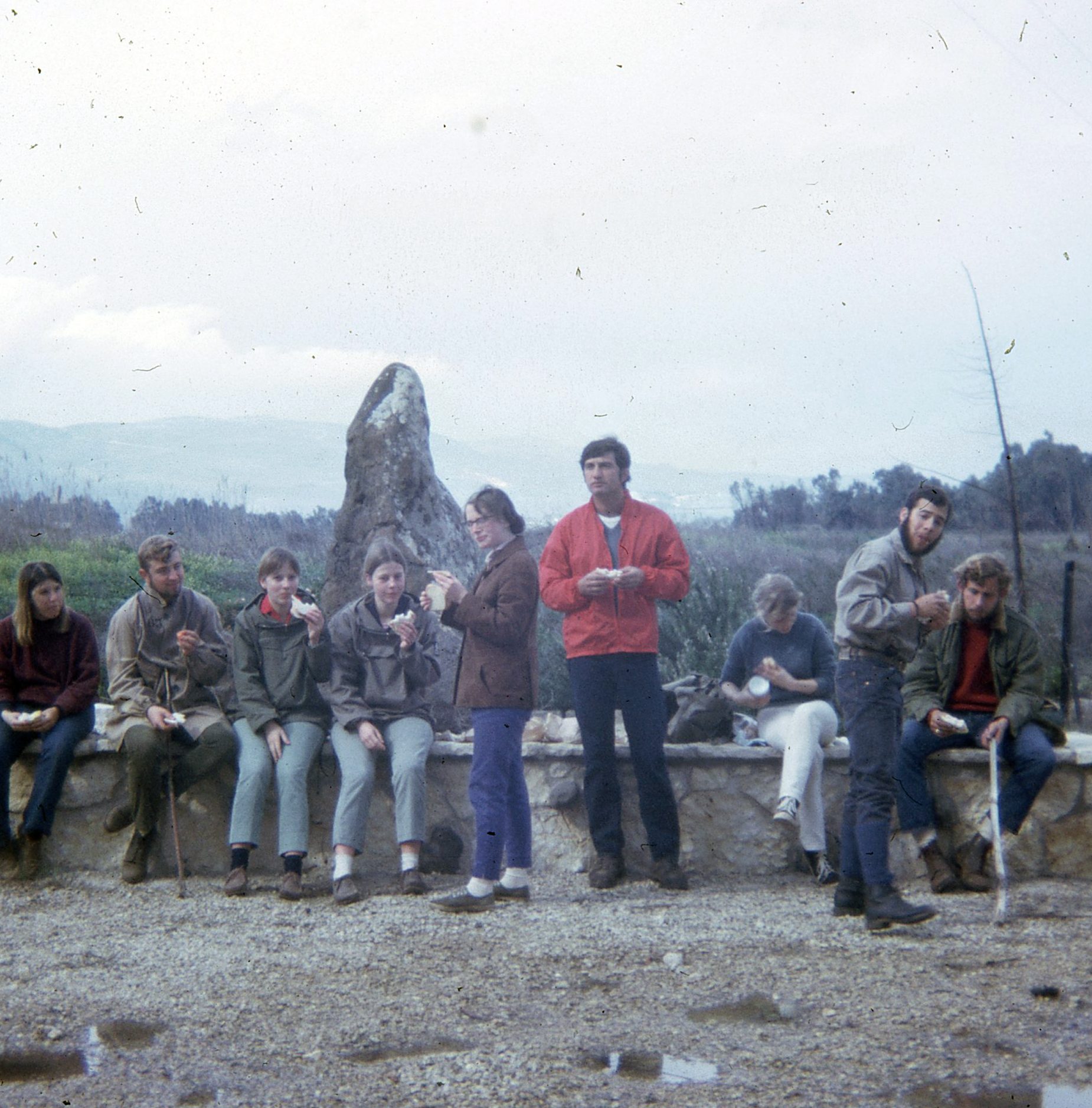
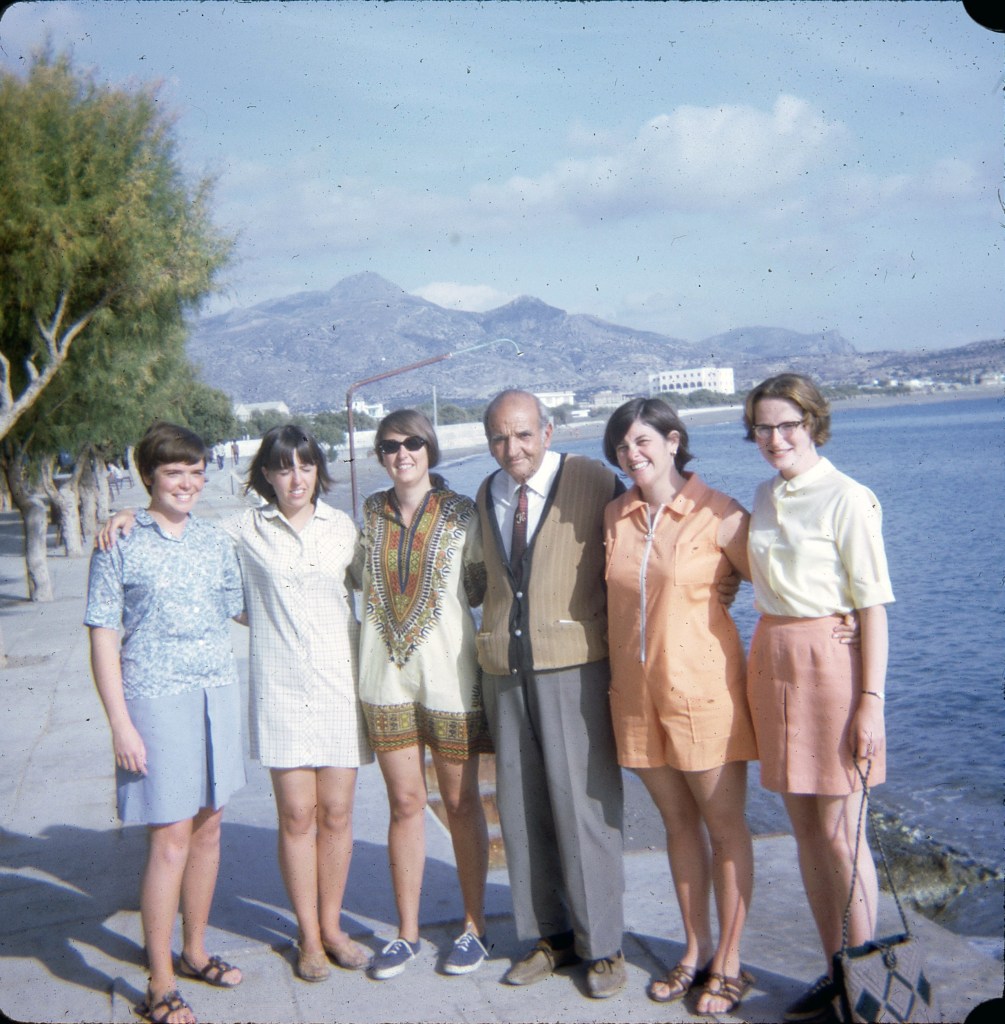
Not forgetting my Aunt’s advice, I realised I had to pursue more than an Arts degree, so decided on a teaching degree. Then, after two years of teaching, I managed to save enough money to take a sabbatical for a year to fulfill my life long dream to travel. Along with two girlfriends, the three of us having graduated without rings on our fingers, we took off to backpack in the year of 1969/70 around Europe, Israel and Turkey on $5 a day.

Thank you dear Aunt Dee Dee for your support and guidance which was one of the best things I have done in my life.

I Am So Excited

“What was the last thing that got me excited?” I must admit there hasn’t been much to get me excited lately. Nevertheless, as soon as I read today’s prompt, my first thought went to Kamala Harris’s acceptance speech and the joyous reception it got from all those who were there to be a part of what could become one of this century’s most historic events.

I actually felt my adrenalin rising causing chills throughout my body and my heart to flutter. Mind you it was all in a good way. Most of the time when I hear the latest political news about my country, Canada, and that of so many other countries around the world, I am left with a sense of despair.

Kamala, as we have come to call her, has to be one of the bravest people on the planet to take on the job of winning over the confidence of her fellow Americans especially those who support her opponent. Somehow, she must gain the confidence of all of those who feel left out, such as those of colour, new immigrants, the poor and disadvantaged, the youth who are now able to vote, and those who have been so discouraged they have given up voting.

She faces huge challenges more crucial than anything her predecessors have. Never has there been a woman President of the US one of the most influential countries in the world. She will somehow have to address much of the mess that she has inherited from those before her. Let’s face it! Never have there been so many wars going on all over the world at the same time. Never has the world had to face a rapidly changing climate and how to deal with it. Never has our world been faced with having to change almost everything we have ever known, such as our past beliefs, old traumatic experiences, and outdated customs to name a few. We are being forced to make changes to our thinking and old habits so quickly. We can’t do it on our own so we need strong and open-minded leaders to help take us on this journey. It truely is boiling down to a matter of survival. I am feeling confident that Kamilla is the kind of leader we need: a beacon of light we will need to begin the process of making our world a better place to live in.

Daily writing prompt
Tell us about the last thing you got excited about.

An Unforgettable Meeting With the Queen

Even though we had been aware that our Queen Elizabeth was showing signs of coming to the end of her long reign as well as her life, when the world was told on Thursday, September 7th, that she had passed on, many of us were left with a feeling of shock and sadness. Wasn’t it just a few days before that she had inducted the new Prime Minister of England into office, a tradition that has been carried out by the reigning monarch of the UK for eons?

No matter what anyone may think about the value for maintaining the monarchy these days because of its cost at a time when a large part of our world is suffering from famine, climate change disasters, war and terrible injustices, the Queen’s death has revealed to us that there is something very worthwhile about it after all. The debate about abolishing the monarchy has been ongoing for almost as long as the Queen’s 70 years on the throne. The fact that she, a woman who wasn’t the next in line but unexpectedly inherited this responsibility because her uncle abdicated the throne so he could marry a divorced woman, put her in the position of ruling over one of the world’s oldest empires.

Seventy years is a long time to have to reign over an increasingly more complicated role as the British monarch for the “Commonwealth of Nations” which reached to the far corners of the world. Gradually as the world population increased and became more connected, many of the countries conquered by the Brits no longer wanted to be ruled by a distant relative who knew little about them and their customs. Wanting their freedom from the monarchy’s tight control, they either set up their own monarchy or elected their own leaders to form a republic. Despite her efforts to connect with her far flung family with more frequent visits and in some cases a first visit from a monarch, she was dismayed to see more than 30 members leave the commonwealth during her reign. Nevertheless, she handled every crisis within her dwindling empire with grace and understanding. On top of this kind of pressure, she also had to handle the precarious position she was put in as a Head of State demanding she be supportive of the numerous changes of government and Prime Ministers in England whether she liked them or not. Again, she was able to handle every political crisis and leader with an astounding knowledge and understanding of their roles. I think there is no doubt in anyone’s mind that she was born to be both a Queen and a Head of State. Totally dedicated to her job with its responsibilities and changes, she revealed such dedication that at times the media blatantly accused her of neglecting her own family. No doubt she did but she never faltered. She came through both her personal and her public life with aplomb.

We, being her people you might say, have always taken a tremendous interest in her personal life. Unfortunately, the media may have expressed too much interest in the the Queen and all the Royals. Many of us will remember the time when Princess Diana was killed in a car crash in Paris in 1997. Unfortunately, the Queen was instantly chastised for the how she handled the tragedy. Why had she waited so long before issuing statement after the tragic news to the people, and why did it take her so long to return London from Balmoral where she was taking a holiday? Did she not care? Was she that much out of touch with the public that she was not there to mourn with all her subjects the death of a young woman who inspired all those she met with a freshness that the monarchy had never seen before? All of this kind of publicity was probably one of the worst times of Elizbeth’s reign. I remember distinctly listening to her annual Christmas speech that year when she described her year as a “horriblis annibus”. Well, to her credit, she took the message from the people to heart because from that time on the whole mood at the palace began to change. She made more appearances and somehow appeared to be more vulnerable as a person whom they could connect to. Yes, she had listened to her people and had learned from them.

During this time, I wasn’t paying much attention to what was going on with the royal family. I had other, more important things on my mind. I remember thinking, however, that the media were making far too much fuss over Diana and being almost cruel to the Queen. I could understand the difficulty Diana would have had dealing with her role as wife to the future king, the protocol that this role required, and worst of all realizing that she had married a man much older than she who was in love with another woman… Camilla…his first love. Of course, the media had a hay day with this family affair making it into a sordid event which must have been extremely difficult for Elizabeth.

Somehow the whole tragic story got absorbed into my subconscious because one night I woke up from a dream I had about the Queen. It went something like this. I found myself enjoying a beer in a typical British pub and sitting across from me at my booth was the Queen! She was casually dressed with no hat and purse. She seemed relaxed and to be enjoying herself. All I could think of was how natural she was and how normal she appeared. Our conversation…can’t remember what we were talking about…flowed so naturally that I felt I was talking to one of my close friends. Not long after that dream, I heard on the CBC news that the Queen was making a huge effort to visit some of the small villages in England that she seldom got to, and that she had actually visited a pub or two. Wow! To this day I fully believe that our dreams sometimes do foretell the future, not just for ourselves, but for others we may know or events that are about to happen.

Now almost two weeks later since her death, the out pouring of love for this remarkable woman has been phenomenal. England hasn’t seen anything like this since the death of her father, King George VI, and the invincible Winston Churchill, the Prime Minister who carried the British through WWII to victory over Germany. There have been many great men, including past Kings of England, who have been proclaimed as heroes but few women. Elizabeth II will be the first to have ever succeeded in her role as Queen for over 70 years making her the longest reigning royal in the world. She will surely be missed for her undying sense of responsibility to a job she never asked for. Once she revealed her vulnerability to her people via the media, we came to see her as a human being dealing with the trials and tribulations of life. She became better at her role as Queen and as a person as she grew older. She never gave up. We have been moved by her death more as the person she was than what she represented in a way that we never anticipated. She has been a great role model for us all and will remain in our hearts for a long time.

God bless the Queen and God save the new King”– A quote from an anonymous admirer.

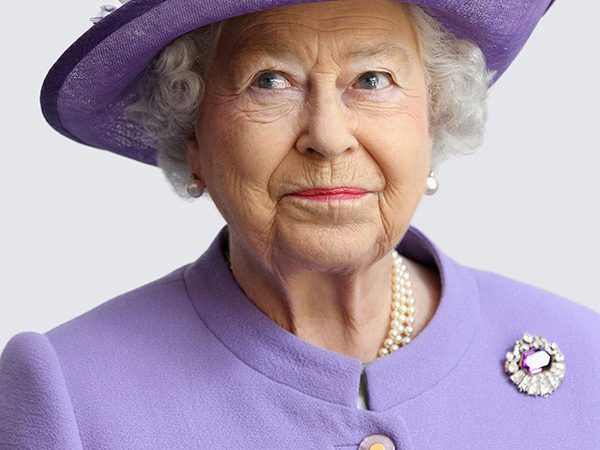
The Queen in her later years.

A Brief Trip to Rome

Rome is now toted as one of the world’s most exciting places to visit…according to Trip Advisor. Their recent reviewers have urged readers and prospective visitors to put it on their bucket list instead of by-passing it as many tend to do. It fact, it came in as the second best place to visit managing to beat out Paris! I suspect that one of the reasons for this is because it’s cheaper. For example, a cappuccino is usually 2 euros compared to five in Paris. Of course, Rome has many other lures,too… history, art and architecture, location, good public transit, Roman ruins everywhere, and the food!

This was a second visit for me having made my first in 1970. With that trip rapidly becoming a fading memory, I was eager to take a few days at the end of our stay in Gaeta and have Hubby act as my tour guide. He has returned to Rome at least eight times so I knew I would be in good hands.

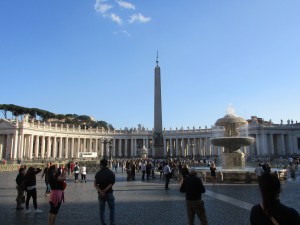
Three days didn’t give us much time to see all I wanted to see. Not keen on standing in line ups to see the Sistine Chapel or St. Peter’s Basilica, I was content to settle for a quick visit to the square to take some pictures and feel sorry for all those who were enduring the line ups. I may live to regret it unless I can return again.

St. Peter’s Square

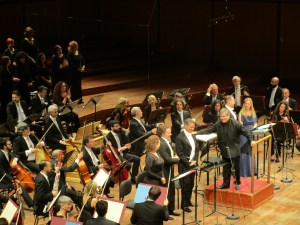
Because we happened to be there at Easter…one of their busiest times of the year… I agreed to attend a performance of the St. John Passion on the outskirts of the city in the Parco de Musica, a park with three modern theatres devoted exclusively to the arts. We attended this event on our first night, to be followed by an overly long, two hour Easter service next Sunday morning. This was enough for me, so from then on it was primarily my choice of what to do and see.

The performers for St. John Passion taking their bows.

Rome is a terrific city for walking. The centre of the city with its numerous piazzas, churches, and famous Roman ruins can easily be done on foot. Places to see are clearly signed and, wonder of wonders, I didn’t find the traffic too chaotic. If you tire of walking or want to go to the outer parts of the city, you can take an easy to manoeuver subway, or a tramcar that runs from one end of the city to the other, or tons of buses which all seem to end up at the Centro Termini where all the trains throughout the country meet up, too. Our hotel was near the station which was convenient for us to get anywhere in the city and out to the airport.

A good deal of our remaining time was spent simply walking and sight-seeing, and most importantly, lapping up the ambience of this eternal city. When our feet and legs began to protest, we had no trouble finding a cute cafe for a drink or for a sample of that delicious Roman food. A favourite ‘pick-me-up’ was an Aperol Spritz in the afternoon. Romans don’t drink cappuccinos after ‘noon’ so feeling obligated to ‘do what the Romans do’ we opted for the spritzers.

One of our first stops was the Spanish Steps…a wonderful Baroque masterpiece designed by that prolific sculptor, Bernini, and constructed in 1726. Next to it, was the one-time home of those two famous English poets…Keats and Shelley. At the top of the steps, I was rewarded with a great view of the city spread out before me. In case you didn’t know Rome is built around seven hills and the Tiber River with no high rises in the centre…. they are all out in the suburbs. There are over 3 million people in all of Rome with over two million in the burbs. The centre has only 80 thousand residents. The crowds of people you encounter are tourists.

View from the top of the Spanish Steps.

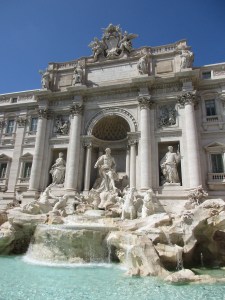
Rome has over 336 fountains which can be found in every piazza, large or small. The Fountain at Trevi is one of the most famous. Immortalized in song and movies, it’s here where visitors flock to throw in a coin or two to ensure that they will return again. I heard that they can haul in up to 2,000 Euro a day!

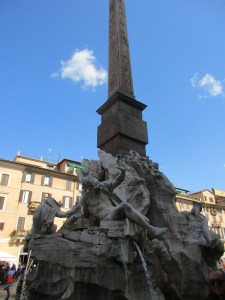
Another beautiful fountain crafted by… you guessed it…Bernini that great Italian sculptor appears in the Piazza Navona. There are two fountains here, but the more significant one is his Four Rivers masterpiece with an Egyptian obelisk in the centre. This plaza dates back to the 1st century A.D. when the early Romans congregated to watch their games. Later on in the Baroque period, they went to see theatrical events. Now it is used for a Christmas market and, of course, for tourists and residents alike to simply rest and have a drink at one of the numerous cafes. It has been featured in many movies: for example “Angels and Demons” written by Dan Brown and starring Tom Hanks.

The Piazza Navona

Bernini’s masterpiece.

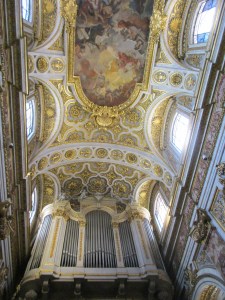
Next to the piazzas in large numbers are the churches. There are many and they are all beautiful. Most of them are now a blur in my mind, but the one which stands out for me is the St. Louis de France boasting three Caravaggio paintings.

Inside St. Louis di France

Caravaggio painting.

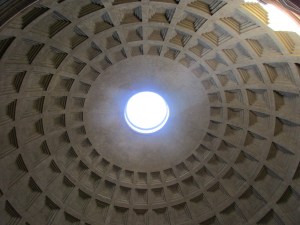
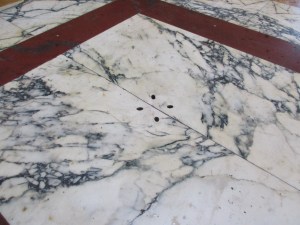
The building which most impressed me was the Pantheon, founded in 27 B.C., destroyed in 80 A.D., and restored by the Emperor Adrian in 118. In the 7th century it was converted to a church. The ancient Romans used it as a meeting place. Over the centuries it became a burial spot for the remains of the Italian kings. Today it can proudly claim to be one of the finest preserved buildings in our modern world. Not only this, it’s one of the few famous pieces of ancient Roman architecture that you can visit for FREE…and there wasn’t a huge line up! Once inside you will be awed by its structure. The huge domed roof with a hole in the centre is made of unreinforced concrete to let the rain in. But where does the water go, and how does this help explain why it is so well-preserved today?  The answer is thanks to the foresight and clever thinking of the builders who put in a sloping floor with small holes for proper drainage so we can enjoy this wonderfully preserved building today.

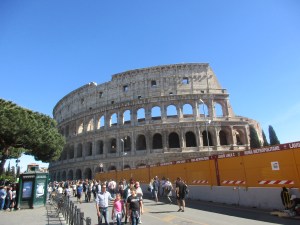
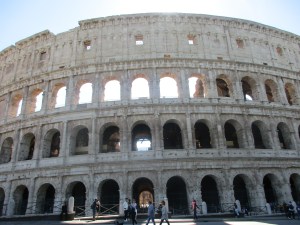
You can’t visit Rome and not visit the Colosseum, if not to enter at least to go and gawk at it. It is the largest amphitheatre ever built. Construction began in 72 A.D. and was completed in 80 A.D. In its day it could hold up to 80,000 spectators who would come to witness drama, concerts, games of all kinds, animal hunts, and the ever popular gladitorial fights.  Again we opted to forego the line up and the crowds to simply admire its grandeur from the outside. Both of us had seen it on our previous visits when it was mostly under construction. Today it is all spruced up and looking awesome. One thing we noticed here, as is true for most of the important ruins and piazzas drawing huge crowds, was the soldiers and sometimes tanks standing guard just in case….

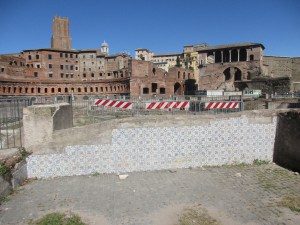
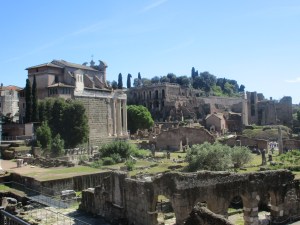
Nearby the Colosseum is the Forum with ruins of temples and monuments scattered here and there. Both of these famous spots are located in what we know today as Ancient Rome. Construction is ongoing and what has been accomplished so far is truly commendable….and it helps bring the tourists! Tons of money has been poured into these restoration projects over the years, not only by the Italian government, but by organizations around the world. The question is how much is enough?

At the Forum with Temple of Minerva.

This mosaic wall looks like a recent find and still is in great shape.

The Temple of Peace built in 70 A.D. after a succession of wars.

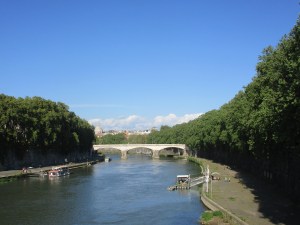
In between the piazzas, churches, and ruins, we found time to visit two villas both housing wonderful collections of art. Our first one was the Farnesina Villa. To reach it, we had to cross the Tiber River. The Tiber is a beautiful river which the Romans don’t give enough credit to. Like the Seine in Paris, it’s spanned by numerous small bridges… all walkable… with a bike/pedestrian path running along it. Strange that not many people use it. Could it be that the steep stairs leading down to the river are a hindrance? Our walk to the villa took us to small cobblestone streets and a world far removed from the frenetic pace of the centre. This area definitely had a village feel to it. The Villa de Fernesina and grounds were absolutely lovely. Antonio Chigi owned this villa and to satiate his passion for the arts became an avid collected of fine paintings by Raphael, Peruzzi, and Baldassairre.
Ralphael’s “The marriage of Psyche and Cupid”

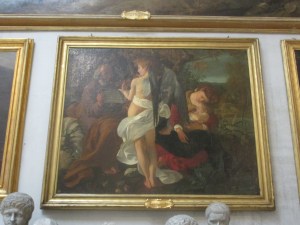
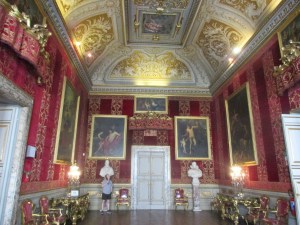
Our second choice was another small gallery in the Villa Doria Pamphily facing the Piazza Navona…back to the centre again. This villa was once the home of Innocent 10 who was proclaimed, not only the pope, but the king of Italy in 1644 or thereabouts. He was one powerful man as was his family. In fact, the family to this day is still involved with running the gallery. Innocent’s cousin, Camillo, was the avid art collector so it’s thanks to him that we can view sculptures by Bernini, and, once again paintings by that very famous artist, Caravaggio, who broke all the rules of his day by insisting on using prostitutes for his models. He really pushed the envelope by using one to portray Mary Magdaline!

Here she is.

A room in the Pallazzio Doria Pamphily.

Rome is facing the same problems, if not more, as most large cities these days. Parking and transportation are and always have been a huge problem, as is housing. There is a whole city underneath the city above waiting to be unearthed. The question is does more money go into that, or should it go towards building a present day city that will provide for the needs of the people living there? Romans seem to be divided on this. The one thing we kept hearing was that they don’t much like change, yet they like to complain about all its ills. It remains to be seen just which direction they will head in. They hated their previous mayor so have elected a young woman. Could she be the answer to helping wake them up to what is facing them down the road? Rome has faced many hard times over the centuries yet it has managed to endure. Surely it will continue to  live up to its reputation as ‘the eternal city’.

In and Around Gaeta, Italy – Roman Ruins and Beautiful Beaches

Spending a month in the town of Gaeta in central Italy has catipulted me back to my high school studies in Latin. At that time, I questioned my choice to study a dead language but was encouraged by the fact that with it came the revelation of how our English language was built on it, and my discovery that Roman history was far from boring. These past few weeks have certainly sparked a renewed interest for me in all things Roman.

Overlooking the harbour in Gaeta.

In their hey day, the Romans spread their empire to many parts of Europe, Asia Minor, and Northern Africa. Most historians today would agree that they were master builders as evidenced by their remains which people have been flocking to for centuries. The Coliseum in Rome, the Pantheon, and the ruins of Pompei and Herculaneum are a few of the notables which have been well-preserved and draw hoards of tourists every year from around the globe.

You could say that the legacy of the Romans is broad enough to cover almost all facets of our life today. Its influence can be traced to the spread of Christianity, the basis of our law system, and our democratic form of government. Other things which come to mind are roads, aqueducts, baths, temples to various gods and goddesses, forums or sports stadiums, coliseums, amphitheatres, and beautiful homes with their *atriums and *peristiles. And, let’s not forget to thank them for a myriad of smaller necessities such as, our newspapers, our calendar, and our public toilets, to name just a few.

In the atrium of a Roman house.

Rome and its environs were the centre for this ancient civilization. However, it was the towns and cities further to the south on the western sea coast sheltered by the Aurunci Mountains, which provided valuable places for trade and places of refuge for emperors and those of the upper class who wanted to escape the clamour of the city. All have their Roman remains with stories to tell of their time spent here.

The Tyrranean Sea and the Aurunci Mt. range.

Gaeta was one of those towns, along with Sperlonga, Formia, and Terracina. These are coastal towns located midway between Rome and Naples. Picture the Almalfi Coast…Capri and Sorrento. This will give you an idea of what this area has to offer: sandy beaches, weird and wonderful rock formations, grottoes, and mountains. No wonder the Romans loved it! Modern day Italians and northern Europeans still flock here in the summer months. March and April are ideal for visitors like Hubby and me because we can not only avoid the crowds and get cheaper prices for just about everything, but also enjoy the sun with moderate temperatures. Nights are cool but days are usually around 18 degrees centigrade.

Overlooking Gaeta

Gaeta, with a population of about 40,000, is divided into two areas: the old and the new which is typical of all the towns we have been….Sperlonga, Terracina, Formia, Itri, and Naples. If not situated on the coast offering beautiful beaches, they can be found further inland on a hilltop in the mountains. All of them have an old and new part, and all of them have Roman ruins scattered here and there. The old parts of town often reveal their Medieval influences with narrow, cobble stone streets, and piazzas or squares usually dominated by a cathedral, town hall, or museum. Larger towns and cities are linked by bus or train running at an affordable cost. A rental car would be the best bet to get to hard to reach places in the mountains but is more expensive. Gasoline isn’t cheap in Italy. We have relied on the bus to get to most places except for Naples when we took the train.

The highlights of our travels in and around the area have been Itri, a small mountain town which lies on part of the Appian Way, the Archeological Museum and the Cavern in Speralonga, the Circeo Promontory and the Temple of Jupiter in Terracina, and Herculaneum near Naples.

The Appian Way was built by the Romans beginning in 312 BC to give their capital a link to the south extending as far as Brundisi. Cutting the rocks, paving the road, and constructing the temples and cisterns must have required careful planning, great expertise and super human endurance. Over the centuries reconstructions have been carried out making it still a viable road even today for automobiles, bikes, and pedestrians. We stopped near the town of Itri to walk on a part of the Appian Way dating back to its beginning. The thrill of our walk was slightly marred by the hordes of mountain bikers who were using the road for racing, a popular sport in Italy.

Watch out, the race is on.

Our walk along the Appian Way.

Itri was the only town we visited that wasn’t on the sea. It’s a small village sitting atop a mountain 170 meters above sea level dominated by a Medieval castle. Being fairly remote from any discernible public transport, we were thankful to have friends with a rental car and an excellent driver to manoeuver the incredibly narrow streets of the Old Town. Here we witnessed the bonfires which are set every year on March 19th to honour St. Joseph. People come out in droves from all over the region to dance, sing, and prepare “zappole di San Guieseppe” a fried dough made of sugar, eggs, and coated with honey. We would have liked to have joined the fun and sampled some of their food, but because there were so many cars leaving no spots to park, we decided to head back to Gaeta for a bite to eat.

A narrow street in Old Town Itri.

This house is for sale.

Sperlonga’s Archeological Museum and Cavern was my top choice for a delightful tour of Roman ruins. The museum portrayed sculptures and artifacts depicting the mythology relating to the battles between Ulysses and the Scylla, leading archeologists to believe that the discovery of this collection in 1957 actually dates back to the Greeks. Over the centuries most of them were reconstructed by the Romans during the reign of the Emperor Tiberius. Not far from the museum is the remains of a village, the villa where Tiberius lived in the summers, and the cavern where his sculptures were hidden. With such an idyllic setting by the sea and the mountains , no wonder Tiberius fled Rome’s heat to spend his summers in Sperlonga.

Sculpture of Ulysses and his men fighting the Scylla.

Ruins of the village where Tiberius lived.

The Grotto where the sculptures were discovered.

Terracina is another coastal town situated near a gigantic rock promontory jutting out into the Trryhanean Sea with the Aurunci Mountains on one side and a fertile plain on the other. The rock was split in two for the construction of the Appian Way, and there are remnants of Roman rule everywhere. On top of the promontory sits the ancient Temple of Jupiter. In the Old Town on the slope of the mountain, narrow, cobblestone streets lead to a piazza which is built on a Roman forum. Presently, the site is undergoing more excavations to unearth an amphitheatre.

The Temple of Jupiter on the Promontory overlooking Terracine.

Unearthing more Roman treasures.

Formia is the closest town to Gaeta. Bus service runs on a regular basis every hour so we took advantage of this for a change of scenery…to try a new cafe for coffee and pastries… and to explore. Formia claims to have a several notable ruins but we discovered that some simply were not accessible. For example, Cicero’s villa is located on a private property. However, we were successful in finding his Mausoleum located near the Appian Way. Cicero was one of the better Roman Emperor’s; however, his reign ended because he was too outspoken, resulting in his death which was common in those days.

Cicero’s Mausoleum

Another indulgence!

Herculaneum was well worth another trip back to Naples for us. Since we had both visited Pompei many years ago on separate trips, Herculaneum was our undisputed choice. Both of these ancient cities were destroyed when Mt. Vesuvius erupted in 79 AD. Pompei gained its notoriety from the body of the little boy covered in a coat of lava. This image, becoming so embedded in our minds over the centuries, caused people to flock to Pompei and bypass Herculaneum. However, in recent years Herculaneum has been gaining popularity because it actually reveals a closer look at ancient Roman life. Their almost intact buildings, pottery, and art are in much better condition. Apparently reconstruction was started soon after an earthquake in 63 AD. It has been ongoing so the whole site is much better preserved. Moreover, Herculaneum was a more compact city with narrow streets and layered buildings ….their version of our present day high rise…which makes it an easier site to walk and do in a day. I remember how spread out Pompei was with its wide streets making it difficult to see everything in one visit.

Ancient Herculaneum with Mt. Vesuvius in the background.

A pub and eatery with the pots used for cooking.

A two layer boarding house.

Many school groups visit to learn their history.

An excellent example of Roman artwork.

The men’s bath house.

The peristile at the House of Argus.


Gaeta is the last place on my list for finding Roman ruins because it seems to have the least amount that are visible. Bits and pieces are scattered around the Old Town in the columns of some of the churches reconstructed during Medieval times. The Italians are very proud of their Roman heritage so wanting to preserve some of it, they became masters of incorporating pieces of what was left into their reconstruction efforts.

An arch in Old Town Gaeta which has some parts probably dating back to the Romans.

The most complete Roman structure in Gaeta is a mausoleum located somewhere on top of Mount Orlando, overlooking the beautiful Serapo Beach. It’s not visible from down below. It was built by the Romans in honour of Munatius Plancus, a Roman senator who spent time in Gaeta. We tried walking up to see it but never made it. The path wasn’t clearly signed, and we had no way of knowing just how far we had left to go. However, what we accomplished was worth our effort. On the way, we got a close up view of the Turco Grotto which comes with a religious story mentioned in the book of Matthew. The story goes that the rock jutting out to the sea was split into two pieces forming the grotto at the exact time of Jesus’ death. We also stumbled upon some rocks, which upon closer look, resembled a small Roman bath and some type of fortification. Our third reward for this strenuous walk was a fabulous view of Serapo Beach which is the longest (1.5 km) and most beautiful beach in this area. This is the beach that is only a 10 minute walk from our apartment, and where we have been working on our tans on those sunny days when the breeze was warm enough.

The split rock named the Turco Grotto.

Can you guess what these ruins are?

Gaeta and its environs are primarily noted as a tourist area today….as a place to escape from the larger cities… as it was in the time of the ancient Romans. That much hasn’t changed, thank goodness. The beaches we have seen are clean with crystal clear waters. There are ample apartments and hotels to stay for as long as you want. Fish, artichokes, strawberries, pears, olive oil, buffalo cheese made from the milk of water buffalo, rustic sausage, and chickling peas (like beans) are some of the foods the area is noted for. All are readily available at good prices in the numerous markets to be found in every town and village. Gaeta’s location between and not far from both Rome and Naples is another plus if you want a reprieve from small town living and fancy the buzz of the large city for awhile. Most importantly, if you are at all interested in the history of the Romans and how it has impacted our present day life, this would be an excellent area to brush up on that, as I have discovered.

That’s Gaeta and its Serapo Beach.

Watching the sun set over the Gulf of Gaeta.

*atrium – the open area of a dwelling surrounded by rooms on all sides as in Roman days. The concept is very popular today.

*peristile – an open garden surrounded by a colonade of porticos.

*triclinium – a formal dining room lined on three sides by reclining benches familiar to the Roman house a wealthy family.