Naples – You Can Love It or Hate It

Before you make up your mind on what your impression of Naples is, you should either read what I am about to write or go and visit it for yourself. If possible I would suggest the latter.

When I was back- packing my way around Europe with my girlfriends, we decided to bypass Naples because of the rumours we had heard and read…”Watch out for all those men who hassle women on their own and be careful of pick pockets.” There were other negative comments I’m sure but this is the one that stuck in my mind. It was definitely not on the ‘bucket list’ of most travellers back then and, unfortunately, not so for some even today. I must confess that I would not have chosen to visit Naples this time around while in Italy if it hadn’t been for Hubby and some friends who lived there in the ’80’s. At first, I met their enthusiasm for this great city with scepticism, but thankfully my open mind and curiosity won over. Here are my impressions of this controversial city which will hopefully give you some idea why people either love it or hate it, or perhaps fall somewhere in between.

Architecture

The proliferation of fine old buildings reflecting a mix of architectural styles including Baroque, Gothic and the more modern art deco designs introduced by Mussolini before the second world war are outstanding. In fact, Naples was declared a UNESCO World Heritage Site in 1995. There are hundreds of beautiful churches, castles and palaces, and famous piazzas commemorating the city’s heroes in its historical centre.

Its Setting

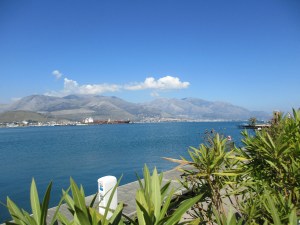
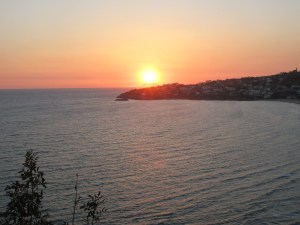
Naples has been gifted with an ideal setting. The beautiful Bay of Naples provides it with one of the world’s busiest ports as well as gorgeous sunsets. It is the launching pad for ferries travelling to one of Europe’s most glamorous regions: the Almalfi coast, Sorrento, and the islands of Capri and Ischia. The mountains of Vesuvius and Campi Flegrei provide another lovely backdrop. Surrounding all of this are miles of fertile land which produce fruit and vegetables year round due to the mix of Mediterranean and tropical climates.

The Narrow Streets

It’s famous for its one-pedestrian, cobble stoned streets strung with lines of laundry and hanging off balconies. Everyday life is highly visible and can be chaotic but that’s Napoli. I never felt unsafe or encountered any rude behavior. Shops with mouth-watering pastries and cafes serving up the best coffee from the region, abound. It’s almost impossible not to stop and sample some of this so why not indulge? As we discovered, a coffee and a delicious pastry will cost 2 or 3 Euros… about 3 to 5 Canadian dollars.

The National Architectural Museum

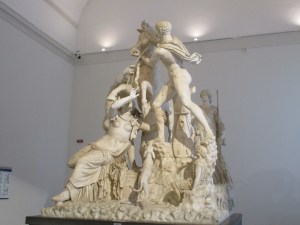
This museum is a must see. It houses one of the world’s most complete collection of  sculptures reproduced by the Romans from their older  Greek compatriots, as well as mosaics and paintings from the cities of Herculaneum and Pompei which were devastated by the Mt. Vesuvius eruption in 79 A.D. The first floor of this magnificent building is devoted to sculptures depicting Roman heroes both real and mythological. You can’t help but be mesmerized by the beauty of both the male and female anatomy…especially those male bums! Another sculpture which should not be missed is the “The Torture of Dirce” or the Farnese Bull carved from one solid piece of Italian marble. Michelangelo worked on its restoration. The second floor is filled with lovely mosaics and paintings rescued from the ruins of Pompei. Apparently you can see more of how life was lived at that time than if you went to visit Pompei itself. In recent years a little room portraying the sex life of the citizens has been added. Now dubbed the ‘porno room’ it has drawn considerable attention. My thoughts on this display were that it’s not so different from the tantric sex motifs one can view in India. Good for Napoli for daring to portray the reality of their past life.

The Torture of Dirce sculpture built AD 212 to 216.

Teatro de San Carlo

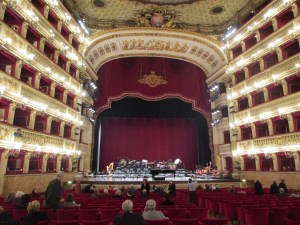
The ornate Teatro de San Carlo was built in 1737 making it the oldest working theatre in Europe. We were fortunate to hear one of the best symphony concerts I have ever heard, not only because of the wonderful acoustics but also the program conducted by Leonard Slatkin from the US. His excellent conducting skills, the appearance of Alexi Volodin, a Russian pianist who received two encores and could have had more, and an interesting modern piece composed by Slatkin’s wife, Cindy McTee, made this a memorable evening. The icing on the cake was accidentally meeting Slatkin and McTee at the Architectural Museum the following day where we had a great chat about the previous night’s performance and other things musical. Hubby was in his element sharing stories of great conductors and musical performances he attended during his employment at Roy Thompson Hall in Toronto.

The Cappella Sanservero

The Sansevero Chapel Museum is a sepulchre located in the heart of Naples. Created by Giueseppe Sanmartino, its prime focus is the Cresti Velato or Veiled Christ. People of strong faith, or not, can’t help being moved by the intricate realism of this sculpture where every nuance of Christ’s suffering is vividly portrayed in his body shrouded with a thin veil so real you can almost feel it. Many other masterpieces can be found in this chapel making it one of the ‘most impressive monuments ever conceived by the human mind’.

Neapolitan Food

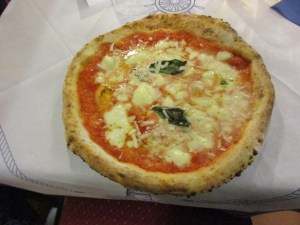
As all Neapolitans would like us to know, pizza was invented by them, but did you know that the Margherita pizza is named after Queen Margherita and that the ingredients for a true Neapolitan pizza are regulated by law? Since 2004 only a special kind of flour, yeast, and mineral water can be used so only those restaurants who meet these requirements can claim they make the ‘real thing’. Patrons of these restaurants will know because each restaurant must display a special logo at their entrance. The Neapolitans also lay claim to being the masters of spaghetti especially the seafood dish. Then, as I already mentioned, there are those yummy pastries which again they are masters at producing. Napoli’s signature pastry is called a sfogliatelle….light layers of flaky pastry filled with sweetened ricotta cheese.

Art and Culture

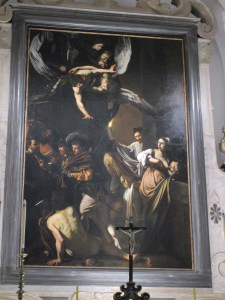
Their art and culture, which goes back centuries, is still very much in evidence today especially in their churches and major museums. After admiring the Duomo, the largest and most significant of Naples’ churches, we visited the Misericordia where Michelangelo Caravaggio’s famous art piece …”The Seven Acts of Mercy”…is housed.  Another major undertaking exposing the culture of the Romans is ongoing. An underground city under the present day city is slowly being unearthed and giving us a close up of early Roman life.

Caravaggio’s “The Seven Acts of Mercy”

There are numerous other sites for which Naples is noted, but I would need at least a week or more to see them all. They are all the things that people love about this city. Now for the things that some people hate about it so much that they have vowed never to return.

Garbage

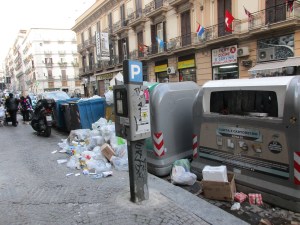
A few years ago, Naples made the world news when the garbage collectors went on strike for more than a year. You can imagine the problems this created which didn’t do anything to help the city’s already negative image. I hate to say that even though the strike is over the city is still having some problems. Although some garbage bins were visible, there were not enough as garbage was usually spilling out  around them, not to mention everywhere else. Nevertheless, I don’t think their problem is much worse than many of the cities I have seen in South East Asia, such as Phnom Penh in Cambodia and the country roads in Viet Nam. Proper garbage disposal and the citizens’ concern for keeping their cities or towns litter free simply aren’t a priority in many parts of our world. For Italy it has always been Naples and many contribute this to the poor choice in municipal government influenced by the Camoura, an organized crime network.

Graffiti

Yes, there is a good deal of graffiti in Naples, which I don’t think is worse than some other European cities I have seen. I remember that Lisbon and Athens both had problems with it as I suspect many other European cities have. Walking around the historic centre of Naples, I spied one shop keeper painting over some of the graffiti on his storefront. It is a shame that the city hasn’t been able to stem the tide as it does contribute to its overall grungy, dirty appearance.

Begging, Touts and Pickpockets

Naples is one of the poorest places in Italy so there is bound to be begging with desperate people looking to make money any way they can. I noticed some begging around the Central Train Station but none on the trains or the subway. We were approached by one tout who wanted to help us purchase our tickets, but he backed down fairly quickly when we stated firmly that we didn’t need his help. We experienced much worse in the medinas of Morocco.

Lying, Cheating, and Thieving

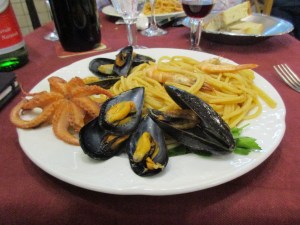
Over the years Naples has been accused of them all. During our two-day visit, we encountered only one incident: lying. This happened where we least expected. After finishing a delicious Neapolitan meal of antipasta, seafood spaghetti, red house wine, and frizzante (fizzy water), and of course, the crusty bread served at every meal, we were presented with our bill which totalled 55 Euro…about $80 Canadian. We were astounded! Hubby had eaten at this restaurant last year and paid much less. This was our reason for returning…good, authentic food cooked up by the family who run the place and at very good prices. They had no real menu other than a set price for whatever they were cooking for the day and another higher price if we chose what we wanted. He told us they had seafood pasta so we thought, why not, if that’s what is on the menu for the day. He didn’t present any other options. When Hubby picked up the bill the whole place heard a loud, “What”? Immediately our waiter left our table and returned with a new price of 45 euro! Having looked at their pricing for the two sets (with or without choice) as we were entering the restaurant and seeing that the counter offer still wasn’t good enough, I jumped in and pointed to the sign at their door. Realizing again that he didn’t have a strong rebuttal, he brought the price down to 40 euro. Allowing for the possibility that prices had gone up from last year, we stopped at this point and paid our bill. If we hadn’t been so savvy, he would have gotten away with it. Too bad as this is the sort of thing that Napoli has been known for and why people are reticent to go back.

Neapolitan seafood spaghetti.

My conclusion on Napoli is that like many cities it has its good and bad points. If you go looking for the good, with an open mind, and some common sense, you will accept it for what it is and leave on good terms. However, if you buy into the negative hearsay and look only for its bad points, you will come away with the wrong impression and never want to return. If you choose the latter route, then I think you will have missed experiencing a city which is vibrant and real. Beneath the layers of grime you will find beauty and the remains of a storied past.

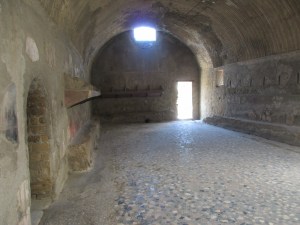
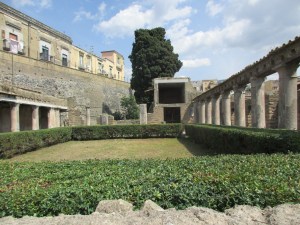
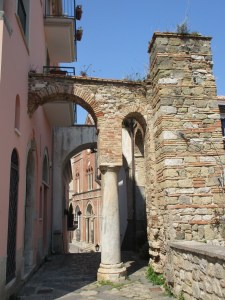
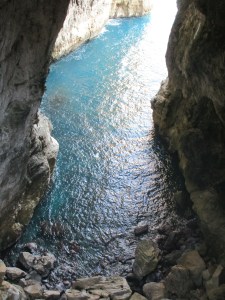
A gallery of additional images of Napoli. Click on each picture for the caption.

A Greek Pictorial

  • Friendly people
  • Ancient history
  • Sheep, goats, and cats
  • Olives and lemons
  • Blue sky and water
  • White-washed buildings

These are the primary impressions of my most favourite country in the world – GREECE.

Last year I revisited this beautiful country on my way home from the Far East where I met up with my husband after three months of solo travel to Thailand, India, and Nepal. This was a return visit for both of us having each landed there what seems like eons ago in 1969. However, we were not together then. Young and still single, I had contacted the travel bug after two years of teaching elementary school and was travelling with a group of girlfriends, while he was travelling with his former wife and two small children.

My second time around last year was far more rewarding since I now had the opportunity to see Greece through more experienced eyes and truly fall in love with it all over again. As an added bonus, we arrived in April before the cruise ships and hoards of tourists on board, so we often felt like we had the country to ourselves, at least on the islands we visited. It also meant that accommodations and meals were within our budget which they most certainly would not have been later on during the peak season.

The following gallery of slides is meant to give you a bird’s eye view of the impressions that my second visit to Greece left with me. I know I will return again should the opportunity present itself.

This slideshow requires JavaScript.

Paris in Three Days

I love Paris in the spring time. I love Paris in the fall…..” These words are dancing in my head as I put together this last post for the end of our winter getaway. We  began our odyssey in Thailand, spending over two months there, mostly in Chiang Mai, where I shopped for my small import business and had some dental work done. From there, we flew over  to Cambodia to explore this small but fascinating country for a month, followed by another couple of weeks back to Chiang Mai dealing with some unfinished dental work. We began to wend our way westward and home taking a one month hiatus to visit Portugal for the first time. There we managed to meet up with my brother and sister-in-law in Lisbon for a few days. Since we had a connecting flight from Paris to Montreal, we seized the chance to spend three days in this beautiful ‘city of light’  knowing we might never have such an opportunity again.

We managed to cram in many of  Paris’ highlights in our three days and would have liked more time but were just as glad we didn’t for this is one of the most expensive cities in the world to visit, especially for travellers on a budget like us. Instead of taking in all the museums and historical sites that charge huge entrance fees, we spent much of our time just walking around and enjoying the parks. I also devoted much of my time trying to capture the beauty and spirit of this city with my camera. The result is a short story of what we saw and experienced in those three days. I hope you enjoy them as I take you through the picture gallery I have attached to this post. To view each photo up close, simply click on the first picture and take the journey from there. Please feel free to make any comments or ask any questions you might have after viewing them.

Journey to the North – the Cradle of Portugal

Portugal is a small country but that doesn’t mean that it has not great contrasts in its geography and, hence, its people and customs. Travelling from the Algarve, the southern most region of the country, to Porto, the second largest city and capital of the north, in less than ten hours by train will give you some idea of its size. If you look at a map, you will realize it’s actually dwarfed by its neighbour, Spain. From my train window as we travelled from Portimao to Lisbon, the view was one of  green hills, some cactus, palm trees, and miles and miles of orange groves revealing a rather dry climate.  However, once we were past Lisbon, the geography began to take on a different look. I noticed the orange trees were being replaced by many other kinds of trees more reminiscent of Canada, which meant this area received more rainfall and was cooler. We were, after all never far from the Atlantic coast. As we got closer to Porto, I actually began to feel like I was entering a different country. The terrain was changing and so were the houses. Where had all those strange looking chimneys I saw in the small towns in the south disappeared to? Now the rooftops were orange-tiled with just ordinary chimneys.

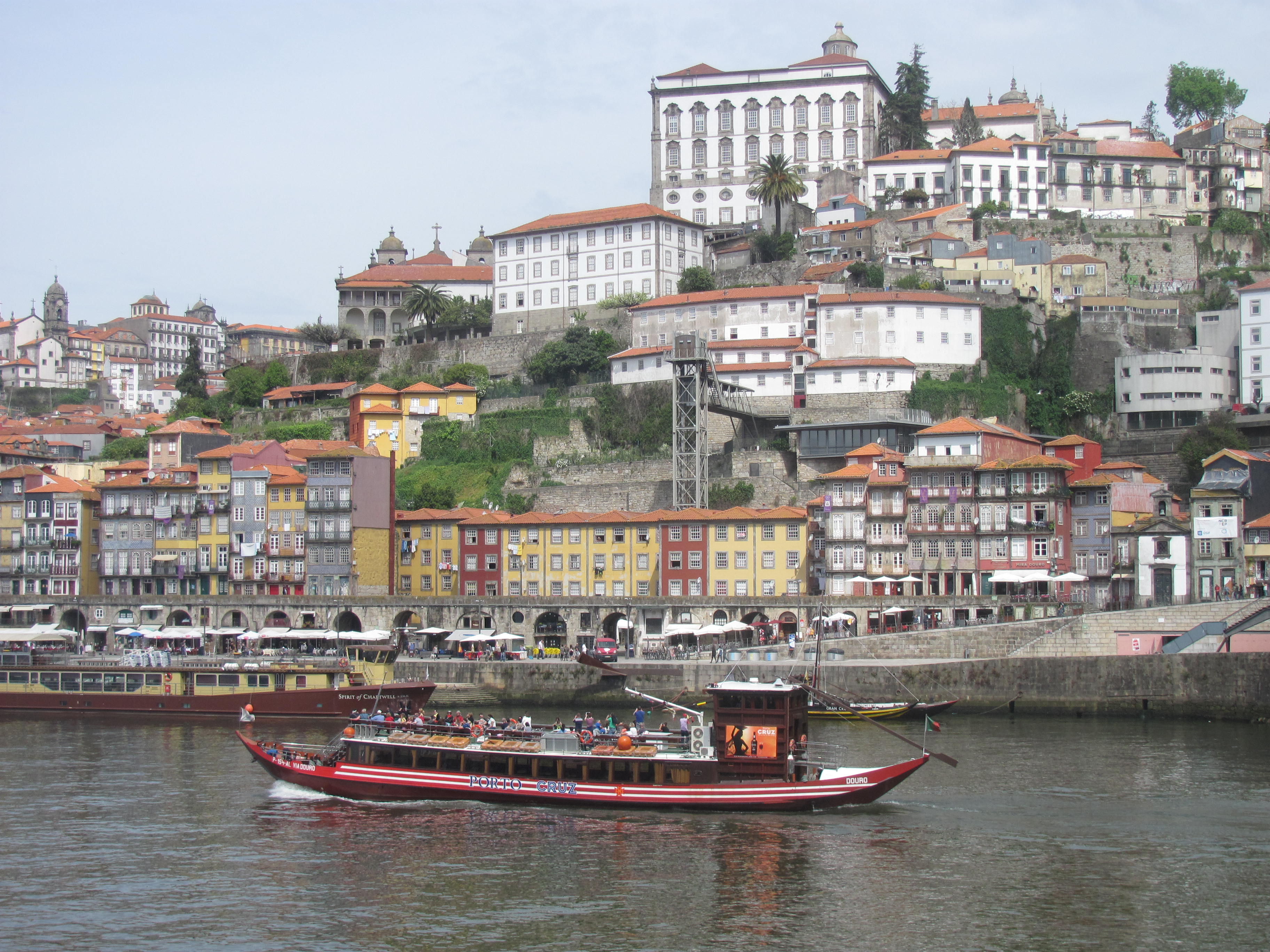
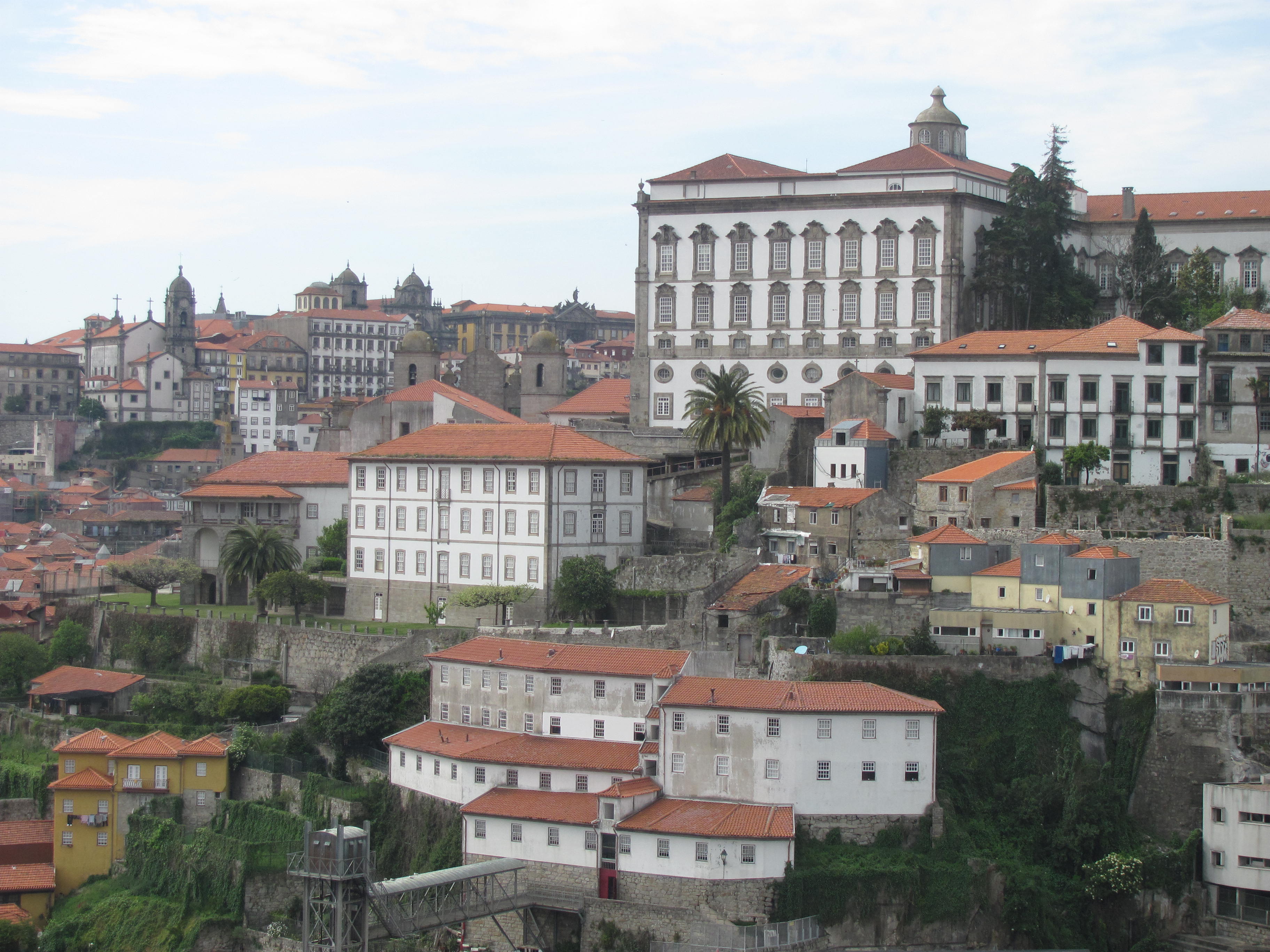
Our entrance into Porto was dramatic to say the least. I instantly understood why the historic part was declared a UNESCO site in 1998 and why everyone we had spoken to about our itinerary for Portugal insisted that we visit Porto. I think the other reason for this advice was to sample the port wine for which Porto is famous. I will come back to port making later. Porto literally clings to the steep rise of mountains on the north side of the Duoro River. Our train approached it from the mountains lining the south banks of the river on the Villa Nova da Gaia side giving us a breathtaking view of both cities and the six bridges that span them. The whole vista was nothing short of spectacular!

To add to our excitement of seeing this old city, we got a taxi driver who waxed relentlessly about how Porto was the ‘heart and soul’ of Portugal and far more interesting than Lisbon which was merely the capital. He talked constantly with much help from his hands all the way to our hotel which did cause me to wonder if we would ever get safely to our destination, get settled in, and have the opportunity to find out for ourselves just how wonderful it all was.

After this hair-raising ride, we simply left our unpacking, and headed down the steep hill to the riverside while we still had the light of the setting sun. Miraculously we got down in about 15 minutes without a problem noting that this city, like most cities and towns we have visited in Portugal, is actually smaller in area than it looks because of how the numerous winding streets meander around the hills upon which the heart of the city rests. For the first time visitor, it can be confusing and frustrating especially if two people tend to approach the whole business of getting oriented to a new place in completely different ways. For example, my husband doesn’t believe in maps and refuses to even look at them. He uses what he calls his instincts and stops every five minutes to ask directions of those poor unsuspecting locals who in most cases can’t speak  a word of English. In contrast, I do use maps to try and get my bearings and will only ask someone for directions if I’m totally lost. At this point, I won’t elaborate any further on the complications and arguments these two approaches lead to, other than to say that somehow we muddle through and eventually get to our destination all in one piece as happened that first night.

The Duoro River at sunset.

The Duoro River at sunset.

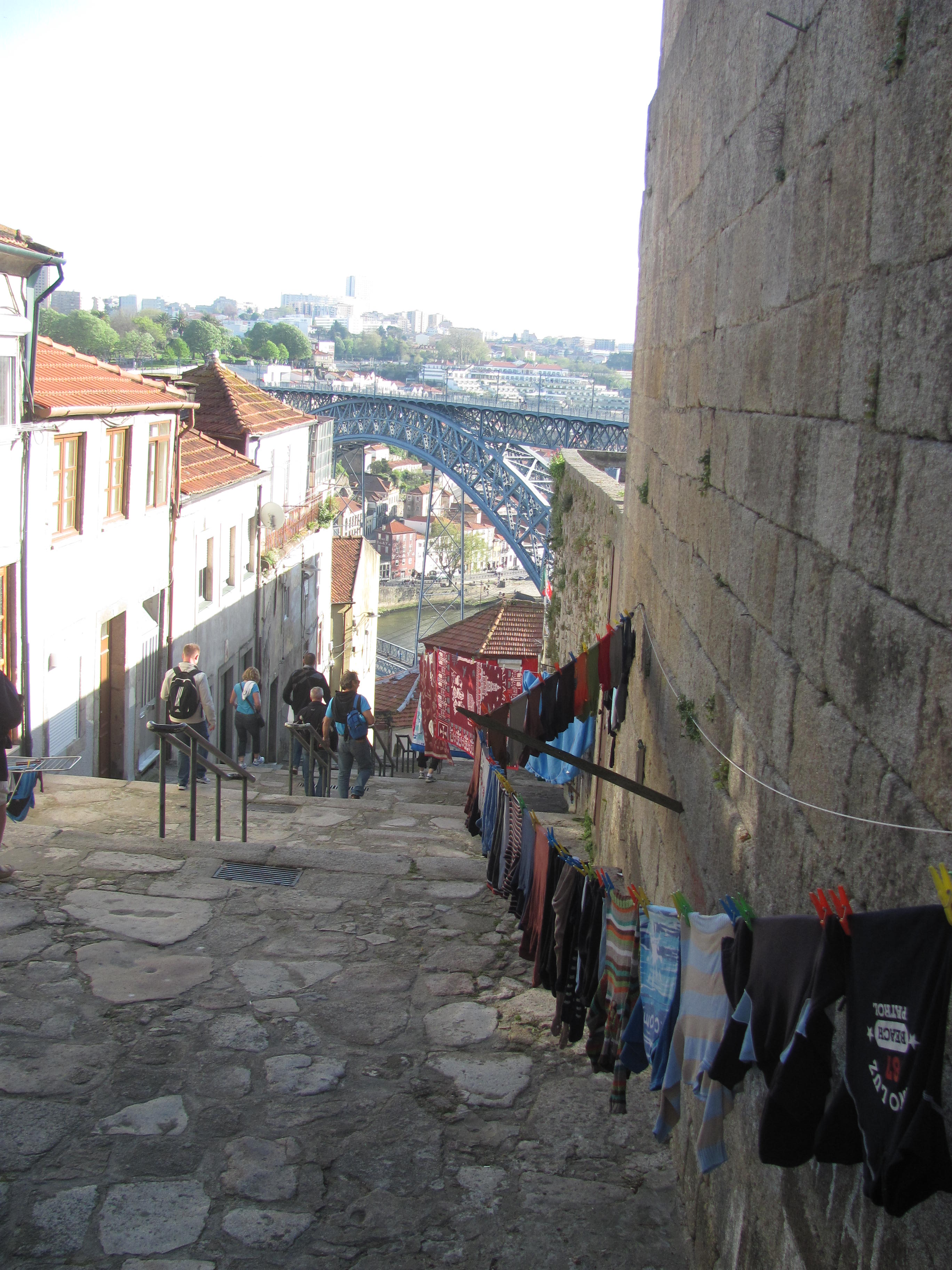
Narrow street leading to Porto riverside.

Narrow street leading to Porto riverside.

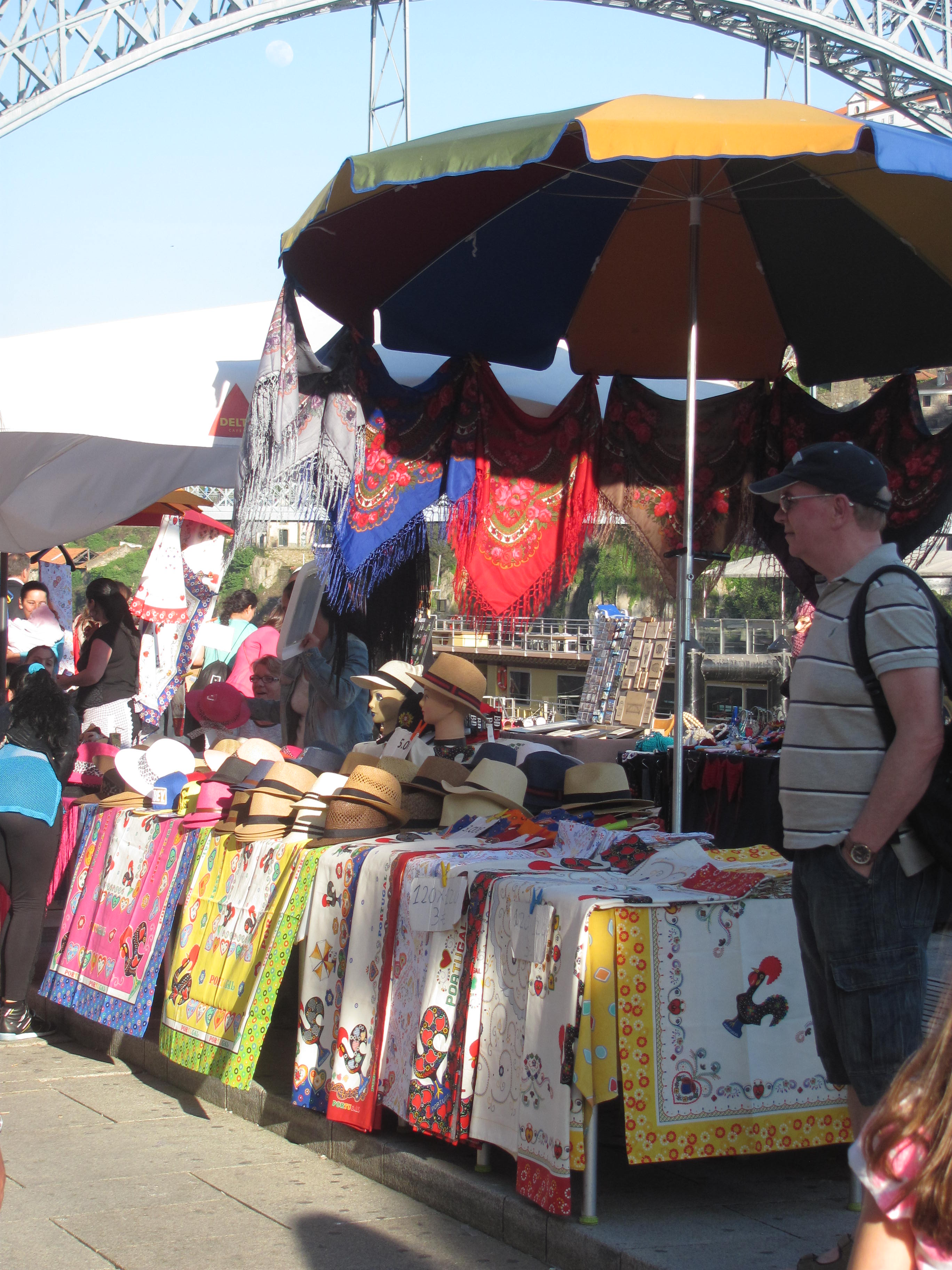
Market along the riverside.

Market along the riverside.

Riverside entertainment.

Riverside entertainment.

The next day did not turn out nearly so well. Hubby decided he must attend an Anglican church service to which he had managed to become a welcomed participant in their choir. While he was rehearsing, I found a nearby park to sit in and enjoy the sunshine. With the help of my map and guide book, I took this time to plan our day. After the service and armed with lots of instructions from the friendly parishoners on how to get to the places we had agreed to see, we set out to find the first one which was the Romantico museum. This museum is the re-creation of a 19th century aristocratic mansion so we chose to visit it thinking it would be a nice change from those which simply depicted Portugal’s history. The other incentive for putting a museum on our list of  ‘must sees’ is the fact that all museums in Portugal have free entrance on Sunday.

Sadly, we never got to see the Romantico. After an hour or more of looking for it, we just couldn’t find it. According to our map and any person hubby could find who had even heard of it, it was nearby and very close to where we were. No problem, you will see it, they said. I forgot to mention this was another reason for my suggesting it in the first place because according to my map it was right on the edge of the park I had been sitting in. We did eventually find out where the museum was but only from a tourist information centre where English is spoken. It was in the area where we looked but enclosed within a large dome which we could see the whole time, but who would have thought? Certainly not us! I would like to think that we have both learned a lesson from all this should we ever decide to return to Portugal, and that would be that maps and asking anyone on the street can be useful, but not to ignore the tourist information centres and to be patient with some of them since they more than likely will have long lineups. We can’t do it all on our own, and we can save ourselves much aggravation (and quite possibly a marriage) by taking the time to seek out the people who are trained to help and most importantly have good English skills.

Finally frustrated and thirsty, we decided to abandon this idea and go for the next one on our list which was the Majestic Cafe described in my guide book as  “belle epoch coffee house, just the place to enjoy cakes and scones”. This sounded wonderful to both of us so off we went full of anticipation for what was ahead. Unfortunately, it was further away and more complicated to find than I had anticipated and to cap it all off, the place was closed because it was Sunday! By this time hubby’s mood was getting worse by the minute and any good deeds he might have prayed about in church had quickly evaporated. As for me, I was more than ready to quit my job as tour guide and give the thankless task to him. Because we were famished by this time, we sat down at the nearest sidewalk cafe which was advertising tapas (sandwiches) and a drink for 3,50 euro. This was the best luncheon deal we had found in all of our almost four weeks here, and it was also delicious! At last something good had happened. At this point, I made my resignation as tour guide official and gave the responsibility to him for the remainder of the day.

This new arrangement worked for both of us resulting in our day taking a turn for the better. We continued on exploring a couple of the larger more ornate cathedrals in the centre of the city, admiring the carvings of saints and angels, the gold statues, and beautiful tiles. Almost every building in Porto has some kind of tile work on it. The old train station was probably the biggest surprise having the interior entirely covered in tiles depicting scenes from Porto’s colourful past.

A tiled cloister in the Gothic style of Porto's largest and most sacred cathedral.

A tiled cloister in the Gothic style of Porto’s largest and most sacred cathedral.

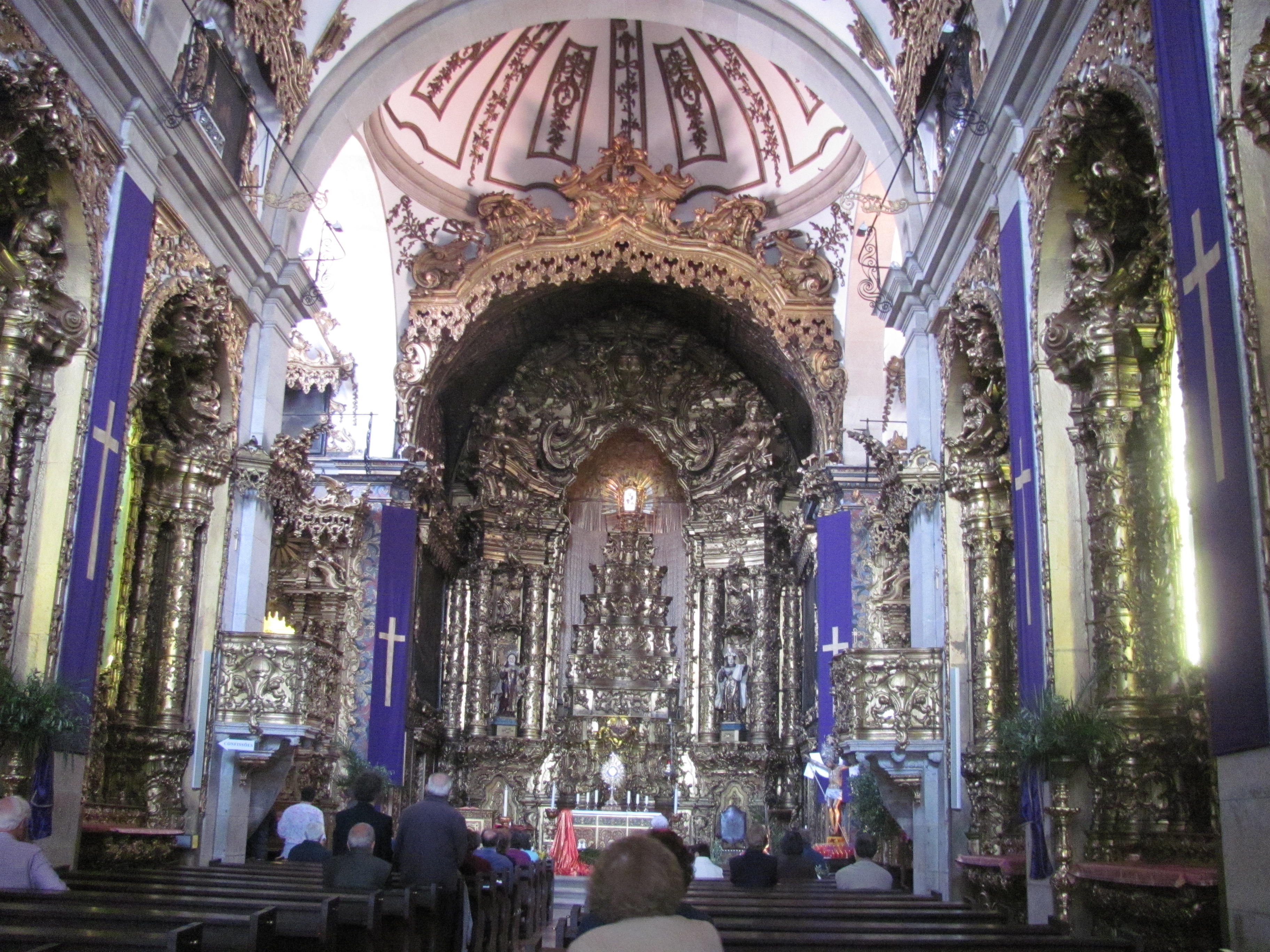
The interior of a typical Portuguese church.

The interior of a typical Portuguese church.

Some of the tile in the old train station.

Some of the tile in the old train station.

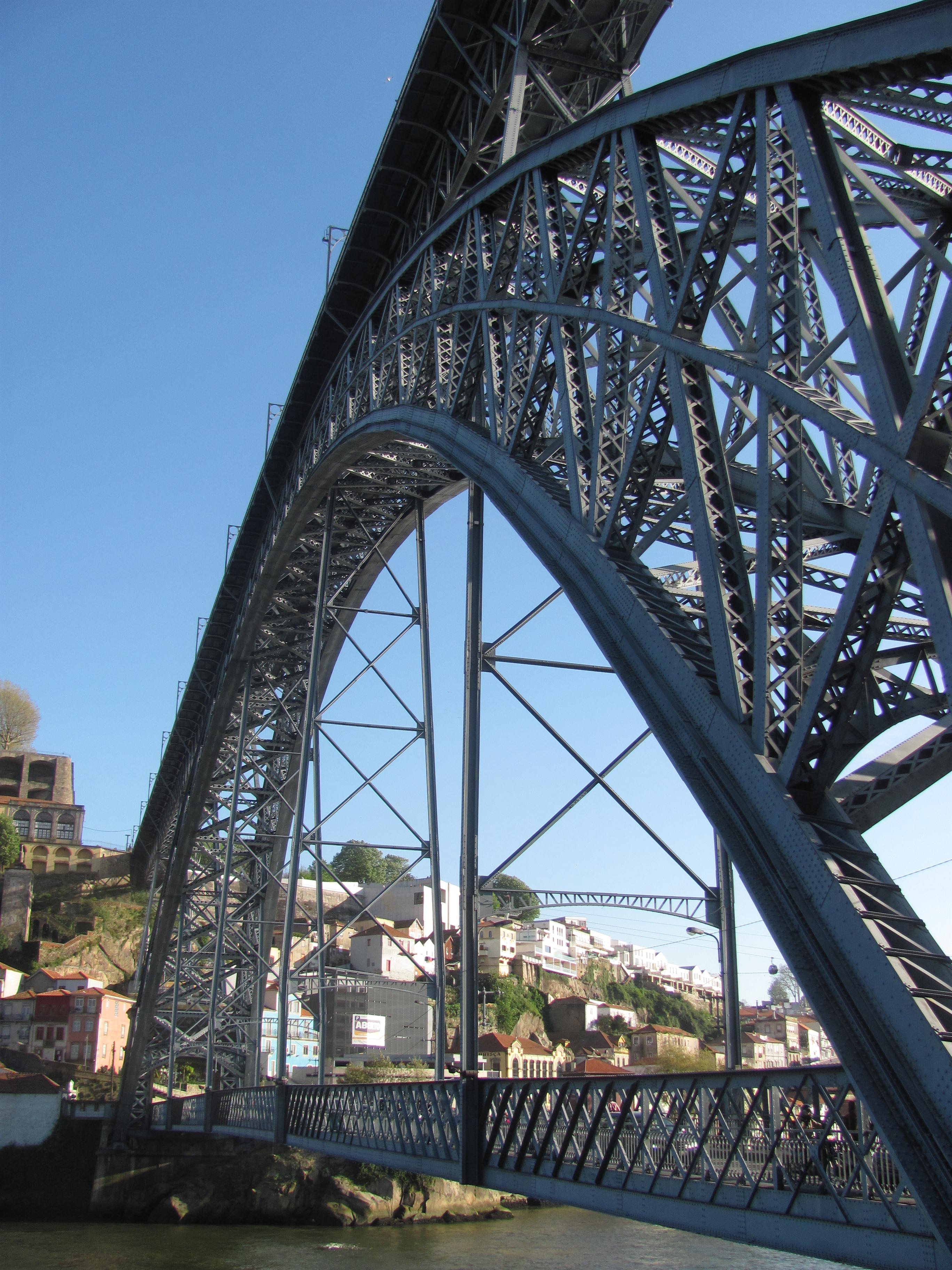
The next day, Monday, turned out much better. In fact, I would rate it as one of the best we’ve had since coming to Portugal. Waking up to a beautiful sunny day with a warm breeze, we set out for Vila Nova de Gaia, the home of the port wine trade. We walked across the Ponte Dom Luis I, one of the six bridges spanning the Duoro. This bridge was designed by a pupil of Gustave Eiffel and is constructed in two levels. We walked over the lower level which gave us easy access to the riverfront of Vila Nova with gorgeous views of Porto across the way.

The Dom Luis I bridge with upper and lower levels for crossing.

The Dom Luis I bridge with upper and lower levels for crossing.

Picturesque Porto from across the Duoro River.

Picturesque Porto from across the Duoro River.

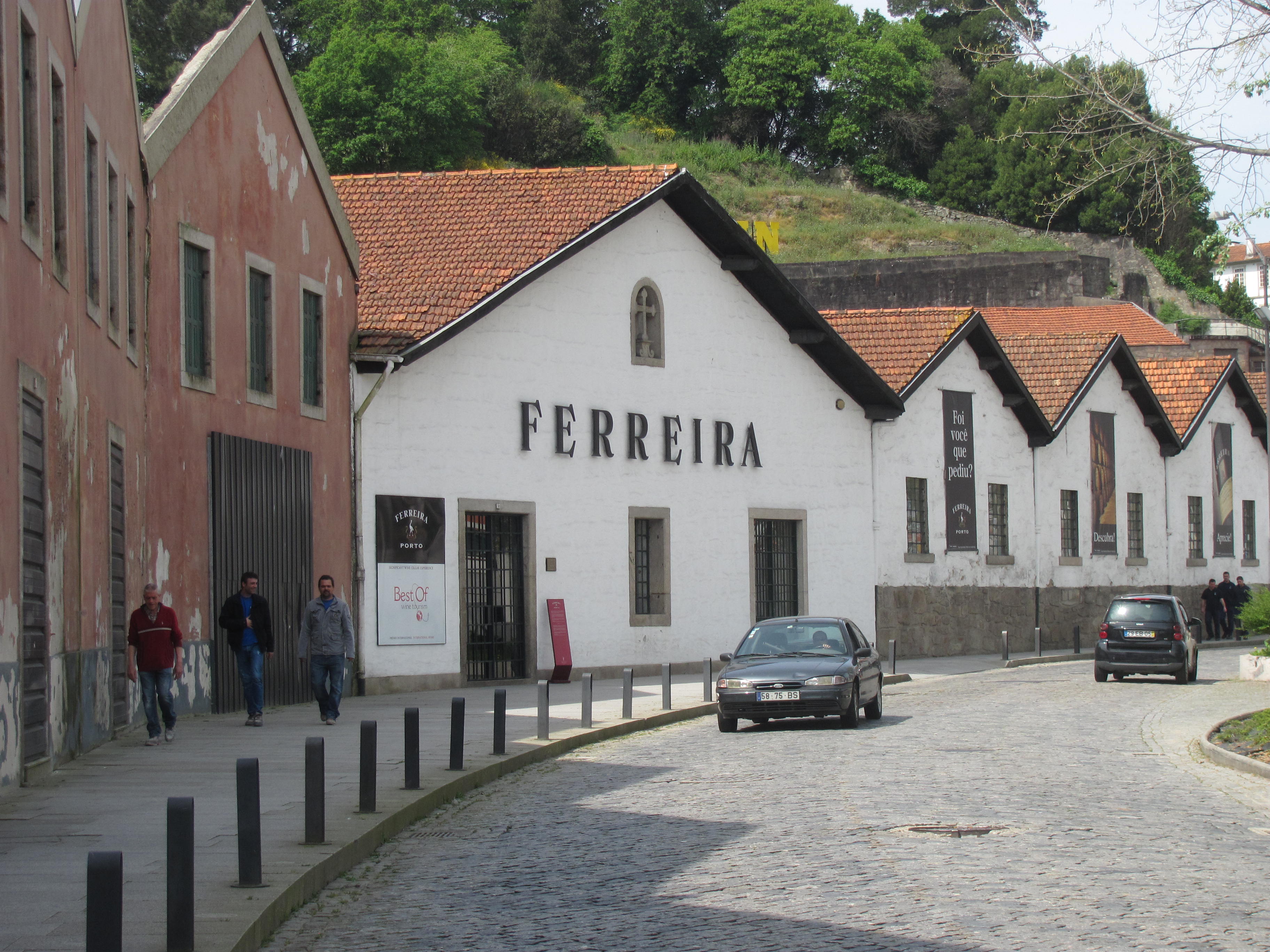
There are many port lodges lining the riverside of Vila Nova with Sandeman’s being the number one choice for every tourist and tour bus due to its familiar logo of a  man wearing a Spanish sombrero and black Portuguese cape. Because we like to be different and go where the tour buses are not likely to go, we chose to go to Graham’s, and you can guess why. This loja, the Portuguese word for warehouse, sits away from all the rest on top of a hill overlooking the town. In spite of the steep climb, we were so glad we made this one our choice. We were not only met with the most incredible view of the river with the two cities on either side, but also the friendliest staff imaginable. Our guide for the cellars and host of the tastings was Isobel, a lovely young lady who conveyed to us and four young lads from Holland, the history of port making in Portugal and the intricacies of its making in impeccable English. Curiously, many of the loja have English names and that is because many of them were originally started by the British as early as 1790 when their supply of port was no longer available from France. It was then that George Sandeman saw this opportunity and build the first one in Porto because the region just east of here was perfect for growing the kind of grape needed to produce the same quality as that which was produced in France.  Today port production is a thriving business in this region.

One of many wine lodges in Vila Nova de Gaia.

One of many wine lodges in Vila Nova de Gaia.

Graham with our tour guide at Graham's winery.

Graham with our tour guide at Graham’s winery.

After our tour, we were treated to three different tastings: a deep red port which apparently was Winston Churchill’s favourite, a vintage red, and a delicious tawny. Three small drinks was enough to go to my head, and since there was a restaurant on the premises showcasing tasty looking tapas at an affordable price, we opted for two a piece as our lunch. While sitting on the terrace with our tapas, wine, and a view to die for, we had the good fortune to meet two interesting couples: one from Germany and the other originally from the US but now living in Germany. What is it about good wine or port that always brings out interesting conversations? In the end, we both agreed that all of this combined to make our trip to Vila Nova a memorable one which more than made up for our previous, better to be forgotten day.

Now the fun really begins!

Now the fun really begins!

Some Portuguese tapas.

Some Portuguese tapas.

The view from the restaurant at Graham's.

The view from the restaurant at Graham’s.

On our return to Porto, we were faced with several options as to how to cross over the two level bridge. We could have used a cable car for 5 euro each, or the metro train for one and a half euro, or walk back across on the lower level from whence we came, or take a funicular up to the higher level at a cost, of course, or lastly dare to climb up the cobblestone street leading on to the higher level to not only walk across for free, but also have the best view possible. We opted for the last because we already had spent enough money for this day, and we were glad we did. Making stops along the way helped, and viewing the port scenes from such a height for the last time made it all seem much more worthwhile.

A view of Porto from the upper level of the bridge.

A view of Porto from the upper level of the bridge.

Taking the time and making the effort to go to the northern part of this picturesque country was a wise decision. Portugal seems to be a country divided into three main parts: the south along the Algarve which has become famous as a haven for Brits and many other tourists escaping from the harsher climates of their countries, the centre which has the historic capital of  Lisbon, and the north which the Portuguese claim is the cradle of Portugal. It was the north that produced the country’s last and longest ruling dynasty, the second largest city of Porto, along with Lisbon, and to give birth to and play a prominent part in the Age of Discovery – that era when many of their seamen set out to explore and find new lands such as, Brazil, India, parts of Africa, and Malacca in Malaysia. These discoveries provided them with untold riches of gold and gems to furnish their churches and palaces which we are looking at today as tourists. Furthermore, the north has provided the world with the grapes and facilities to make the finest port in the world.

Beaches, Oranges, and Fado

If I had to sum up my most memorable things about the Algarve region in the south of Portugal, these three things are it – the beautiful beaches, the abundant orange trees, and the soul moving music of known as fado.

The number one reason why the Algarve draws so many tourists is for its beautiful beaches. True, there are scads of beautiful beaches in this world, but the ones here are exceptional for their sandy beaches, rocky cliffs, little coves hidden beneath the grottos, and outcroppings of rocks which seem to pop up everywhere. Even though they are influenced by the cold Atlantic, they are, nevertheless, a whole lot warmer especially on the leeward side towards the Spanish border. Since we have been comfortably settled in Portimao for the past two weeks and now that the sunny weather for which this region is known has returned, we have been visiting some of these nearby beaches. In fact our favourite, the Praia da Rocha about a kilometer away from our apartment, has won some kind of award for being the most beautiful beach in Europe.

Sandy beach at Lagos.

Sandy beach at Lagos.

Rock outcroppings on Praia da Roche

Rock outcroppings on Praia da Roche

One of the many grottos.

One of the many grottos.

On my first days here in the Algarve as we walked around getting to know the town of Lagos, I couldn’t stop smelling the loveliest aroma imaginable. I soon realized it was the delicate aroma of the orange blossoms from the trees which seemed to be everywhere, from everyone’s back yard to the trees lining the boulevards. Interspersed among the orange trees were the lemon trees just dripping with huge lemons. Seeing this started my quest for getting the perfect photo of the orange tree…and the orange! I wasn’t too enamored of the lemon tree because once I had tasted one of those oranges I was hooked on them! Oranges and fresh orange juice have been a part of our daily diet. However, not to exclude those luscious lemons, we have been using them to enhance the flavour of our cooking.  I just wish we could bring home bags of them, not just for the taste, but for the cost which is a third of what we pay in NS.

Orange trees everywhere - a farmhouse near the town of Silves.

Orange trees everywhere – a farmhouse near the town of Silves.

Oranges and blossoms in spring time.

Oranges and blossoms in spring time.

Orange blossom.

Orange blossom.

The Algarve's perfect orange.

The Algarve’s perfect orange.

Fado shouldn’t be on the list of memorable things reminiscent of the Algarve, but of Portugal as a whole and especially Lisbon, since that is where it had its beginnings. However, I had to include it here because this is where we heard the most heart-wrenching singing and music ever, right here in Portimao, making it my third most memorable thing about this beautiful region. This type of singing, sung only in Portugal, evolved from the taverns and brothels of the port of Lisbon in the 1820’s. It’s taken from the Portuguese word saudade meaning nostalgia. The story behind the mournful singing by a fadista (female singer) is one of bittersweet longing for some kind of loss, usually a lover or death of a loved one. The fadista is accompanied by a Portuguese guitarist, a classical guitarist, and in more modern times as we experienced last Saturday night, perhaps a set of drums or other modern instrument. Of course, the whole performance was sung in Portuguese; nevertheless we could pick up the drift of the theme just by the tone of utter angst and the actions of the fadista. She and her backup band were absolutely sensational at pulling in their audience (the encore went on for at least half an hour) leaving us with an unforgettable impression of a genre of music that was almost new to us. We had both heard it before on a CD which was recorded in the 1960’s probably by Amalia Rodriguez, Portugal’s diva of fado, which would have been very traditional without all of the modern backup.

Portugal is of course known for many other things too numerous to see or even mention.  However, I would be very remiss if I didn’t pay tribute to the the cuisine and architecture we have encountered. Portugal is a maritime nation like Nova Scotia so it’s cuisine is defined by the fish that come from the sea. Unfortunately like us in NS, the Portuguese have over fished so now most of their fish come from Norway. However, this doesn’t mean that fish don’t play a big role in the kinds of dishes which are at our disposal. We have sampled delicious creamed cod, grilled bass, grilled sardines (their specialty), hake, salmon, and shrimp, but no lobster. They fish very few lobster here.

The market in Loule.

The market in Loule.

Reproduction of the sardine packers at the Portimao National Museum.

Reproduction of the sardine packers at the Portimao National Museum.

We have explored castles built by the Moors in the 1200’s and admired the Moorish architecture which is still evident today in the homes and buildings as in their chimneys and the tiles. The strange looking chimneys resemble small minarets and can be seen on almost all homes.  The tiles or azulejo for which Portugal is famous can be found in many of the churches, train stations, homes, and public buildings.

Typical chimneys on the homes in the Algarve.

Typical chimneys on the homes in the Algarve.

A completely tiled house in Lisbon.

A completely tiled house in Lisbon.

Tiles from a church in Loule.

Tiles from a church in Loule.

There is still so much to see and do in this country so it’s with regret that we have to leave soon. We needed to put down roots for awhile here in Portimao, but now that the end of our stay is near, we are feeling compelled to squeeze in a couple of remaining places on our ‘must see’ list. The first is the lovely seaside town of Tivara very near the the Spanish border, and the second is the town of Sagres in the opposite direction at the furthermost tip of the country reaching out into the Atlantic Ocean. After this, we are scheduled to leave by train for the city of Porto, the capital of the northern region and centre for the vineyards producing the best port in the world. Hopefully, my next post will be about what we encounter in our travels to these three places.